
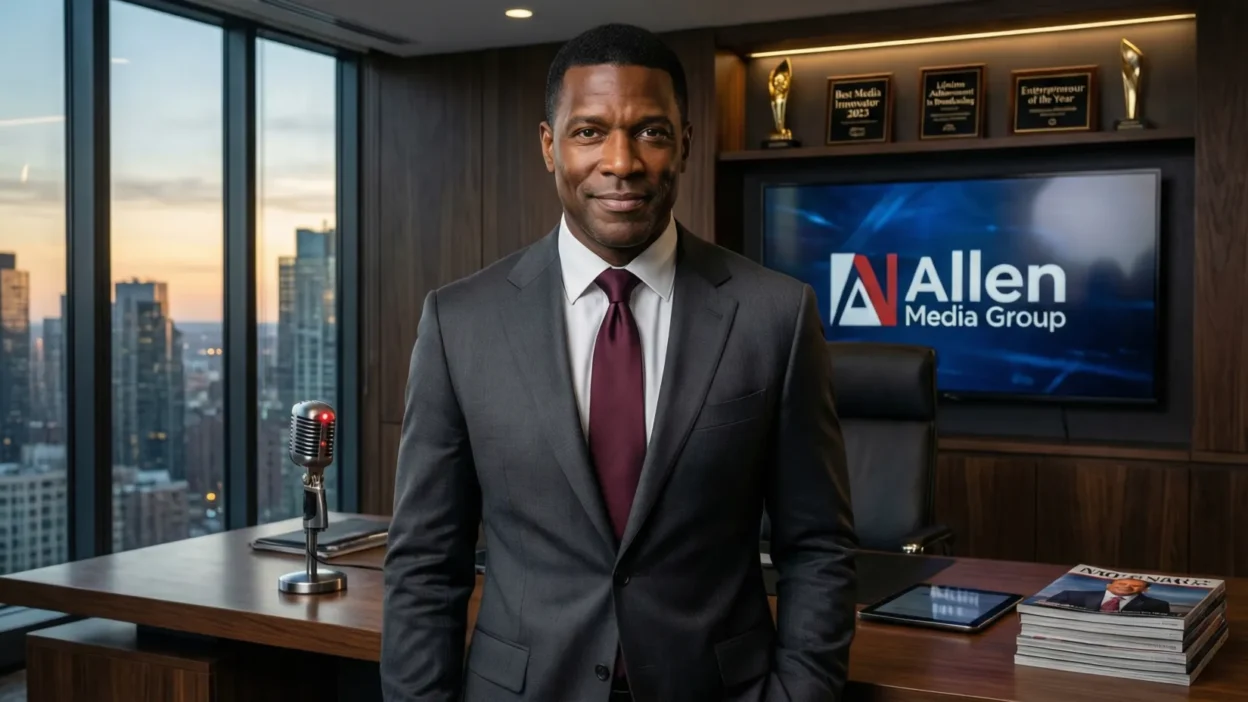
Byron Allen is one of the most powerful and least publicly visible billionaires in the American media industry.
While many people recognize him from his early days as a stand up comedian, far fewer understand how he quietly built a multibillion dollar media empire behind the scenes.
Today, discussions around Byron Allen’s net worth highlight not just his personal wealth, but a remarkable story of ownership, strategy, and long term vision.
From founding Entertainment Studios in the early 1990s to acquiring major assets like The Weather Channel and dozens of television networks, Allen has transformed himself from on screen talent into one of the largest independent media owners in the United States.
His journey challenges traditional Hollywood success stories and offers valuable lessons in entrepreneurship, media economics, and generational wealth building.
In this article, we take an in depth look at Byron Allen’s net worth, how he made his money, and the business decisions that continue to shape his growing fortune.
Byron Allen Net Worth Overview
As of 2025–2026, Byron Allen’s net worth is estimated to be approximately $1 billion, placing him among the wealthiest media entrepreneurs in the United States. While exact figures vary depending on valuation methods and market conditions, most credible financial sources estimate his wealth in a range between $800 million and $1.2 billion. The fluctuations largely stem from the private nature of his businesses and the changing value of media assets.
Unlike traditional celebrities who earn primarily through salaries or endorsements, Byron Allen’s wealth is built on ownership. The majority of his net worth is tied to Allen Media Group (formerly Entertainment Studios), a privately held media conglomerate that owns cable television networks, local broadcast stations, digital platforms, and film distribution operations. Because these assets are not publicly traded, their valuations are often conservative, meaning Allen’s true net worth could be higher than publicly reported.
A significant boost to his valuation came from strategic acquisitions, most notably The Weather Channel, which added both brand power and recurring advertising revenue to his portfolio. In addition, Allen’s ownership of dozens of local television stations across major U.S. markets provides consistent cash flow, particularly during election cycles when political advertising surges.
Another factor that strengthens Byron Allen’s net worth is his extensive real estate portfolio, which includes luxury properties in Malibu, New York City, and other high value locations. When combined with his long term, low debt investment approach, these assets contribute to steady wealth growth rather than short term spikes.
Overall, Byron Allen’s net worth reflects disciplined expansion, media consolidation, and a business philosophy centered on control and scalability rather than celebrity exposure.
Early Life and Background
Byron Allen was born on April 22, 1961, in Detroit, Michigan, and spent much of his early life raised by his mother, Carolyn Folks. Her influence played a critical role in shaping Allen’s mindset, particularly his views on ownership, discipline, and long term planning. At a young age, Allen was exposed to professional environments, often accompanying his mother to work, where he observed how businesses operated behind the scenes.
Allen later moved to Los Angeles, California, where he attended high school and quickly discovered his talent for comedy and storytelling. He was an exceptional student and demonstrated strong communication skills, which helped him stand out at an early age. While still a teenager, Allen began performing stand up comedy at local clubs, showing a level of confidence and maturity uncommon for his age.
His big break came when he became the youngest comedian ever to perform on The Tonight Show Starring Johnny Carson. This appearance opened doors across Hollywood and gave Allen national exposure while he was still in his teens. However, rather than focusing solely on fame, Allen paid close attention to the business mechanics of television production, syndication, and advertising.
After graduating high school, Allen briefly attended the University of Southern California, though he ultimately chose to pursue his entertainment career full time. During this period, he appeared on various television programs and comedy showcases, gaining firsthand experience with contracts, revenue structures, and network negotiations.
These early experiences laid the foundation for Allen’s future success. While comedy introduced him to the industry, it was his early understanding of ownership and control that ultimately set him on the path toward building a billion dollar media empire.
Comedy Career: The Foundation of His Success
Byron Allen’s rise in the entertainment industry began with stand up comedy, a field that provided him with early visibility and invaluable industry access. As a teenager, Allen quickly gained recognition for his sharp observational humor and confident stage presence. His historic appearance on The Tonight Show Starring Johnny Carson made him a national name and positioned him as one of the most promising young comedians of his generation.
Following this breakthrough, Allen became a regular presence on television. He served as a host and performer on shows such as “Real People”, “Solid Gold”, and several comedy specials throughout the late 1970s and 1980s. These roles provided consistent income and exposure, but more importantly, they gave Allen insight into how television programming was created, distributed, and monetized.
Unlike many entertainers who focused solely on performance, Allen paid close attention to contracts, syndication agreements, and advertising models. He recognized early that while on screen talent could earn a comfortable living, true wealth in entertainment came from owning the content and distribution channels. This realization became a turning point in his career.
Although Allen achieved success as a comedian and television host, he understood the limitations of relying on performance fees alone. Comedy, in his view, was a stepping stone rather than the end goal. It allowed him to build relationships, understand audience behavior, and learn the economics of television from the inside.
By the late 1980s, Allen began shifting his focus away from performing and toward production and ownership. His comedy career had provided credibility, industry access, and startup capital key elements that enabled him to transition into entrepreneurship. This strategic pivot ultimately set the stage for the creation of Entertainment Studios and the massive media empire that would define Byron Allen’s net worth.
The Birth of Entertainment Studios
In 1991, Byron Allen made a pivotal move that would redefine his career and financial future by founding Entertainment Studios alongside his mother, Carolyn Folks. Rather than continuing solely as on screen talent, Allen chose to step into the role of media owner and entrepreneur a decision that laid the foundation for his billion dollar net worth.
Entertainment Studios was launched with a clear vision: create, own, and distribute television content independently. In its early years, the company focused on producing syndicated programming, including talk shows, lifestyle content, and comedy based series. Allen personally financed much of the startup, keeping the company privately held and allowing him to retain full ownership and creative control.
One of Allen’s most strategic decisions was avoiding reliance on major networks for distribution. Instead, he pursued direct relationships with local television stations across the country. This approach reduced overhead costs and allowed Entertainment Studios to scale steadily without taking on excessive debt or outside investors.
From the beginning, Allen emphasized content ownership over short term profit. By controlling intellectual property, production, and advertising inventory, Entertainment Studios was positioned for long term recurring revenue rather than one time payouts. This philosophy stood in contrast to traditional Hollywood models, where creators often relinquish ownership in exchange for upfront compensation.
Although Entertainment Studios did not receive widespread public attention in its early years, it quietly expanded its catalog and distribution footprint. The company’s steady growth was fueled by efficiency, strategic reinvestment, and a deep understanding of the television advertising market.
The creation of Entertainment Studios marked the true turning point in Byron Allen’s journey from entertainer to media mogul. It became the platform through which he would later acquire cable networks, broadcast stations, and iconic brands, ultimately driving the majority of Byron Allen’s net worth.
The Revolutionary Business Model: Barter Syndication
One of the most important drivers behind Byron Allen’s financial success is his innovative use of barter syndication, a business model that disrupted traditional television distribution. Unlike conventional syndication, where stations pay licensing fees for content, barter syndication allows stations to air programming at little to no upfront cost. In exchange, the content owner retains a significant portion of the advertising time.
Byron Allen recognized early that many local television stations were eager for quality, low risk programming. Through Entertainment Studios, he offered professionally produced shows for free while keeping control of national advertising slots. This approach made his content highly attractive to stations, enabling rapid national distribution without the need for expensive marketing campaigns or network deals.
The real financial advantage came from advertising revenue. By owning large blocks of ad inventory across hundreds of stations, Allen could sell national advertising at scale. This created recurring cash flow and allowed Entertainment Studios to monetize the same content repeatedly across different markets. Over time, this advertising driven model proved more lucrative than traditional licensing fees.
Barter syndication also reduced financial risk. Because production costs were relatively low and distribution was guaranteed, Allen could experiment with multiple shows without risking large losses. Programs that performed well were scaled up, while underperforming ones were quietly phased out.
This model gave Allen a competitive advantage over larger studios burdened by high production costs and rigid network contracts. It also allowed him to maintain full ownership of his content, reinforcing his long term wealth building strategy.
Ultimately, barter syndication became the engine that powered Entertainment Studios’ expansion. It provided the steady revenue, distribution reach, and control necessary for Byron Allen to acquire cable networks, local television stations, and iconic media assets solidifying his position as a billionaire media mogul.
Expansion Into Cable Networks
After mastering syndicated television, Byron Allen began expanding Entertainment Studios into cable television networks, a move that significantly increased both his influence and net worth. Cable networks offered higher advertising rates, national reach, and more predictable revenue streams compared to traditional syndication alone. This expansion marked Allen’s transition from content distributor to full scale media conglomerate owner.
Entertainment Studios launched and acquired several niche cable channels focused on lifestyle, entertainment, automotive, pets, and minority audiences. These networks included channels such as JusticeCentral.TV, Cars.TV, Pets.TV, Comedy.TV, and Recipe.TV, among others. While these channels did not rely on blockbuster programming, they benefited from consistent viewership and cost efficient production models.
Allen’s strategy emphasized volume and ownership rather than chasing high budget, high risk content. By controlling multiple networks, he created a diversified advertising ecosystem that appealed to national advertisers seeking broad yet targeted audiences. This allowed his company to bundle ad inventory across channels, increasing overall revenue.
Another key advantage was distribution. Allen successfully negotiated carriage deals with major cable and satellite providers, ensuring that his networks reached millions of households nationwide. These agreements added long term stability and increased the overall valuation of his media holdings.
The cable network expansion also strengthened Allen’s bargaining power within the media industry. As his portfolio grew, so did his ability to compete with legacy media companies on advertising and distribution terms.
By building a family of cable networks under one corporate umbrella, Byron Allen transformed Entertainment Studios into a serious media force. This phase of growth played a major role in pushing Byron Allen’s net worth toward billionaire status and laid the groundwork for even larger acquisitions in the years that followed.
The Weather Channel Acquisition
One of the most transformative moments in Byron Allen’s career came in 2018, when Entertainment Studios through a partnership led by Allen acquired The Weather Channel for approximately $300 million. This acquisition marked a major shift in how the media industry viewed Allen, elevating him from a niche cable operator to a serious contender among major media owners.
The Weather Channel was a strategic asset with global brand recognition, a loyal audience, and highly predictable viewership. Weather information is consumed daily, regardless of economic conditions, making the channel extremely attractive to advertisers. By acquiring it, Allen gained access to a powerful platform with built in demand and long term revenue stability.
Beyond traditional television, The Weather Channel also provided valuable data, digital platforms, and licensing opportunities. Weather related data is widely used by airlines, logistics companies, governments, and technology firms, opening multiple monetization channels beyond advertising alone. This diversified revenue model significantly strengthened Allen Media Group’s overall valuation.
The acquisition also enhanced Allen’s negotiating leverage with cable providers and advertisers. Owning a must carry channel meant stronger carriage agreements and improved ad pricing across his entire network portfolio. In many ways, The Weather Channel acted as an anchor asset that raised the value of Allen’s other holdings.
From a net worth perspective, this deal was pivotal. The Weather Channel instantly increased Allen’s asset base and solidified recurring cash flow. It also demonstrated Allen’s ability to execute large scale acquisitions, reinforcing his reputation as a disciplined yet ambitious media mogul.
Ultimately, the purchase of The Weather Channel played a critical role in pushing Byron Allen’s net worth into billionaire territory and redefining his position in the modern media landscape.
Local TV Stations and Broadcasting Power
In addition to cable networks, Byron Allen strategically expanded into local broadcast television stations, further strengthening his media empire and net worth. Local stations remain a powerful and often overlooked segment of the media industry, delivering consistent advertising revenue and strong community influence. Allen recognized their value, particularly in an era when national networks face increasing competition from streaming platforms.
Through Allen Media Group, he acquired dozens of local television stations across major and mid sized U.S. markets. These stations are affiliated with major networks such as ABC, NBC, CBS, and FOX, allowing them to air popular national programming while maintaining control over local advertising slots. This dual revenue structure makes local stations highly profitable and resilient.
One of the most important financial advantages of local station ownership is political advertising. During election cycles, campaigns spend billions of dollars on local television ads, creating revenue surges that significantly boost cash flow. Allen’s growing station portfolio positions his company to benefit heavily from these predictable election year windfalls.
Local stations also complement Allen’s barter syndication model. His owned stations can air Entertainment Studios programming, reducing distribution costs while maximizing advertising revenue. This vertical integration increases efficiency and profitability across the entire organization.
Despite the rise of digital media, local television continues to attract loyal audiences for news, weather, sports, and emergency coverage. Allen has invested in modernizing these stations while maintaining cost discipline, ensuring they remain competitive and profitable.
By building a nationwide footprint in local broadcasting, Byron Allen secured recurring revenue streams and increased the strategic value of his media holdings. This expansion played a crucial role in stabilizing and growing Byron Allen’s net worth, reinforcing his position as one of the most influential independent media owners in America.
Film Production and Distribution
Beyond television, Byron Allen expanded his business interests into film production and distribution, further diversifying the revenue streams that contribute to his net worth. Through Entertainment Studios Motion Pictures, Allen positioned his company as an independent distributor capable of competing with major Hollywood studios, particularly in the mid budget film market.
Entertainment Studios has released a variety of theatrical films spanning genres such as drama, thriller, comedy, and faith based storytelling. Rather than relying on massive blockbuster budgets, Allen focused on controlled production costs and wide theatrical distribution. This approach reduced financial risk while still allowing films to reach national audiences through partnerships with major theater chains.
A key strength of Allen’s film division is its distribution infrastructure. By owning the distribution process, his company avoids the costly profit sharing arrangements common in Hollywood. This ownership model allows Entertainment Studios to retain a larger share of box office revenue, digital rentals, and streaming licensing fees.
Allen also leverages cross promotion across his television networks and local stations to market films efficiently. This internal advertising ecosystem significantly lowers marketing expenses, improving overall profitability. Films that perform well in theaters can later generate additional revenue through on demand platforms, cable licensing, and international sales.
While film production represents a smaller portion of Byron Allen’s net worth compared to television and real estate, it plays an important strategic role. It enhances brand recognition, expands intellectual property ownership, and creates long term content libraries with recurring value.
By maintaining discipline in budgeting and distribution, Byron Allen has turned film production into a complementary business rather than a high risk venture. This diversified approach strengthens the stability of his overall media empire and contributes to the sustained growth of his net worth.
Digital Media & Future Focused Investments
As the media landscape continues to evolve, Byron Allen has taken strategic steps to expand into digital media and future focused investments that complement his traditional television assets. Rather than abandoning linear TV, Allen has focused on integrating digital platforms that extend reach, data capabilities, and long term monetization opportunities.
Allen Media Group operates digital properties connected to its television networks, including streaming apps, websites, and on demand content hubs. These platforms allow audiences to consume content across mobile devices, smart TVs, and desktops, increasing engagement beyond traditional cable viewers. Digital advertising on these platforms provides an additional revenue layer while offering advertisers more targeted options.
A major digital advantage comes from The Weather Channel’s online presence. Its website and mobile applications attract tens of millions of users, generating valuable first party data. This data is used for advertising optimization, licensing, and partnerships with industries that rely on weather intelligence, such as transportation, logistics, and insurance.
Allen has also shown interest in long term media trends, including streaming distribution, content libraries, and data driven advertising. Rather than competing head on with tech giants, his strategy emphasizes owning niche audiences and scalable platforms with relatively low operating costs.
Importantly, Allen’s digital expansion follows the same core principle that built his empire: ownership and control. By keeping platforms in house, he avoids dependency on third party distributors and protects profit margins. This approach allows Allen Media Group to adapt to industry changes without sacrificing stability.
While digital media currently represents a smaller share of Byron Allen’s net worth compared to broadcast and cable assets, it is positioned as a growth engine for the future. These investments ensure his media empire remains relevant, flexible, and capable of generating value in an increasingly digital first world.
Real Estate Holdings
A significant portion of Byron Allen’s net worth is tied to his impressive real estate portfolio, which reflects both wealth preservation and long term investment strategy. Unlike speculative real estate buyers, Allen focuses on acquiring rare, high value properties in prime locations with strong appreciation potential.
One of his most notable holdings is his Malibu oceanfront estate, reportedly purchased for around $100 million. The property is considered one of the most valuable residential homes in California and underscores Allen’s preference for trophy assets with limited supply. He has also owned luxury residences in Beverly Hills, Aspen, Maui, and New York City, placing him among the elite tier of ultra high net worth real estate investors.
In New York, Allen made headlines after selling a full floor condominium at 220 Central Park South for approximately $82.5 million, one of the most expensive residential sales in U.S. history. This transaction highlighted his ability to generate substantial returns through strategic timing and asset selection.
Real estate serves multiple purposes within Allen’s wealth portfolio. It provides diversification away from media related risk, offers tax advantages, and acts as a hedge against inflation. These properties also tend to appreciate steadily, adding to his net worth even without frequent buying or selling activity.
Despite owning some of the most expensive homes in the world, Allen maintains a relatively private lifestyle. His real estate choices emphasize privacy, security, and long term value rather than public visibility.
Overall, Byron Allen’s real estate holdings represent a powerful complement to his media empire. By investing in scarce, high quality assets, he reinforces financial stability and ensures that his net worth continues to grow independently of market fluctuations in the entertainment industry.
Major Acquisition Bids & Business Ambitions
Byron Allen’s growing net worth has enabled him to pursue bold, high profile acquisition bids, reflecting both his financial capacity and long term ambition to reshape the media landscape. In recent years, Allen has made headlines for attempting to acquire some of the largest and most recognizable media assets in the United States.
Among the most notable moves were his bids to purchase major television networks and media companies, including ABC and assets associated with Paramount Global. While not all of these offers were successful, they demonstrated Allen’s ability to mobilize substantial capital and financing partnerships. These bids also signaled to the industry that Allen Media Group was capable of competing with legacy conglomerates.
Allen has also expressed interest in professional sports franchises, including teams in the NFL and NBA. Sports ownership aligns with his broader strategy, as live sports remain one of the most valuable and advertising friendly forms of content in modern media. Even unsuccessful bids strengthened his credibility as a serious institutional buyer.
Strategically, these acquisition attempts serve multiple purposes. They expand Allen’s visibility, increase the perceived valuation of his existing assets, and open doors to future partnerships. In many cases, the publicity surrounding such bids enhances brand recognition without requiring a completed transaction.
Importantly, Allen approaches acquisitions with discipline. He has publicly emphasized that he prioritizes cash flow, ownership control, and long term value over short term headlines. This measured approach helps protect his net worth from overleveraging or speculative risks.
Although not every bid results in a purchase, Byron Allen’s acquisition efforts illustrate the scale of his ambition. They reflect a billionaire mindset focused on consolidation, influence, and building a lasting media legacy that extends far beyond his original entertainment roots.
Legal Battles & Discrimination Lawsuits
Byron Allen’s rise in the media industry has not been without controversy, particularly in the form of high profile legal battles and discrimination lawsuits. Over the years, Allen and Allen Media Group have filed multiple lawsuits against major corporations, alleging racial discrimination in advertising and carriage agreements. These cases have drawn national attention and sparked broader conversations about diversity and inclusion in media ownership.
One of the most prominent legal actions involved lawsuits against large telecommunications and media companies, in which Allen claimed his networks were unfairly excluded from distribution and advertising opportunities because he is Black owned. Allen argued that such practices limited competition and violated civil rights laws. While some cases were dismissed or settled, others advanced far enough to generate significant public and legal scrutiny.
From a financial standpoint, these lawsuits carried both risk and strategic value. Legal battles can be costly and time consuming, but they also placed pressure on corporations to re evaluate their diversity commitments and business practices. In some instances, settlements and revised carriage agreements helped expand the reach of Allen’s networks, indirectly strengthening his media portfolio.
Beyond personal impact, Allen’s legal actions positioned him as a vocal advocate for minority owned media companies. His willingness to challenge industry giants reinforced his reputation as a determined and independent business leader, unafraid to confront systemic barriers.
While legal disputes are not a primary driver of Byron Allen’s net worth, their outcomes have influenced his business growth and industry standing. More importantly, they highlight the challenges faced by independent media owners and underscore Allen’s broader mission to secure equal access and opportunity within the media marketplace.
Income Sources Breakdown
Byron Allen’s net worth is supported by a diversified mix of income sources, with the majority of his wealth tied to long term, recurring revenue rather than one time earnings. This diversified structure is a key reason his financial position remains stable despite shifts in the media industry.
The largest contributor to Allen’s income is advertising revenue generated across his cable networks, syndicated programming, and local television stations. Through his barter syndication model, Allen Media Group controls significant advertising inventory, allowing the company to monetize content at scale across hundreds of markets nationwide.
Another major income stream comes from network carriage fees. Cable and satellite providers pay to carry Allen’s networks, creating predictable, contract based revenue. These fees increase in value as audience reach and brand strength grow, particularly following acquisitions like The Weather Channel.
Local television station ownership provides consistent cash flow through local advertising, retransmission fees, and political ad spending during election cycles. This segment is especially valuable because of its resilience and strong margins.
Allen also earns revenue from film distribution and licensing, including box office receipts, streaming rights, and international sales. While smaller in scale, this segment adds diversification and intellectual property value.
Finally, real estate appreciation and strategic asset sales contribute to his overall wealth. High value property transactions, such as luxury home sales, can generate substantial capital gains.
Together, these income sources create a balanced financial ecosystem. Byron Allen’s emphasis on ownership, recurring revenue, and diversification ensures his net worth continues to grow steadily, even as media consumption habits evolve.
Byron Allen’s Business Philosophy
At the core of Byron Allen’s success is a clear and disciplined business philosophy centered on ownership, patience, and long term value creation. Unlike many entertainers who prioritize visibility or short term earnings, Allen has consistently focused on controlling assets and building systems that generate recurring income over decades.
One of Allen’s most frequently emphasized principles is the importance of owning distribution. Early in his career, he recognized that talent alone rarely leads to lasting wealth. By owning content, advertising inventory, and delivery platforms, Allen positioned himself to benefit from every layer of the media value chain rather than just one paycheck.
Allen is also known for his conservative approach to risk. He avoids excessive debt, favors predictable cash flow businesses, and reinvests profits back into expansion rather than lifestyle inflation. This discipline has allowed Allen Media Group to grow steadily without being overexposed during economic downturns or industry disruptions.
Another key aspect of his philosophy is scalability. Allen prefers business models that can be replicated across markets with minimal additional cost. His barter syndication strategy and multi network advertising structure exemplify this approach, enabling efficient national growth.
Patience plays a central role as well. Many of Allen’s assets took years sometimes decades to reach peak value. Rather than chasing trends, he waits for opportunities that align with his long term vision and then executes decisively.
Ultimately, Byron Allen’s business philosophy reflects a mindset more commonly associated with institutional investors than celebrities. This disciplined, ownership driven approach has been instrumental in building his billion dollar net worth and securing his place as one of the most influential independent media owners in the United States.
Philanthropy and Social Impact
Beyond building a vast media empire, Byron Allen has made philanthropy and social impact an important part of his long term legacy. While he maintains a relatively private public profile, Allen has consistently supported initiatives focused on education, civil rights, and expanding opportunities for underrepresented communities in media and business.
Allen has contributed to organizations that promote equal access, diversity, and economic empowerment, particularly for minority owned businesses. His advocacy extends beyond donations; through Allen Media Group, he has created platforms that increase visibility and ownership opportunities within the media industry. This approach aligns with his belief that true impact comes from building sustainable systems rather than offering one time assistance.
Education is another area of focus. Allen has supported scholarships, mentorship programs, and institutions that help young people gain access to business and media careers. He frequently emphasizes financial literacy, ownership, and entrepreneurship as tools for long term success.
In addition, Allen’s legal actions and public stances on discrimination have played a role in driving industry wide conversations. While these efforts are often viewed through a business lens, they also reflect a broader commitment to fairness and accountability within corporate America.
Unlike highly publicized philanthropic figures, Allen tends to avoid large scale publicity around his charitable activities. His giving strategy mirrors his business approach: measured, strategic, and focused on long term outcomes rather than recognition.
Overall, Byron Allen’s philanthropy complements his business achievements. By reinvesting resources into education, representation, and systemic change, he extends his influence beyond wealth accumulation and reinforces a legacy rooted in opportunity, ownership, and social responsibility.
Lifestyle & Spending Habits
Despite his billionaire status, Byron Allen is known for maintaining a remarkably private and disciplined lifestyle. Unlike many high profile entrepreneurs or celebrities, Allen avoids excessive public displays of wealth, choosing discretion over attention. This understated approach aligns closely with his long term financial philosophy and focus on asset ownership rather than luxury branding.
Allen’s most visible expenditures are his real estate investments, which double as lifestyle choices and financial assets. His luxury homes in Malibu, Beverly Hills, New York City, and other elite locations reflect a preference for privacy, security, and long term value rather than constant upgrading or flashy consumption. These properties are carefully selected and held as part of a broader wealth preservation strategy.
When it comes to personal spending, Allen reportedly prioritizes efficiency and control. He is not known for extravagant car collections, lavish parties, or celebrity driven social circles. Instead, his time and resources are largely directed toward business operations, strategic planning, and family life.
Travel and personal security represent necessary lifestyle costs, but even here, Allen is described as pragmatic. His spending habits emphasize reliability and functionality rather than excess, reinforcing his reputation as a businessman first and celebrity second.
This disciplined lifestyle has played an important role in protecting Byron Allen’s net worth. By avoiding lifestyle inflation and unnecessary liabilities, he preserves capital for reinvestment into revenue generating assets. Over time, this restraint has compounded his wealth and minimized financial risk.
Ultimately, Byron Allen’s lifestyle reflects a broader lesson in wealth management: sustainable prosperity is often built through discipline, privacy, and strategic spending rather than public extravagance. This approach has helped him maintain both financial stability and personal independence throughout his career.
Comparison With Other Media Moguls
When comparing Byron Allen’s net worth and business approach to other prominent media moguls, what stands out most is how differently he built his empire. Unlike figures such as Oprah Winfrey or Tyler Perry, whose wealth grew largely through personal brands and celebrity driven content, Allen focused primarily on infrastructure, distribution, and ownership behind the scenes.
Oprah Winfrey’s success is rooted in a globally recognized personal brand, production partnerships, and equity stakes in high profile ventures. Tyler Perry similarly built his fortune by owning creative intellectual property and studios centered on his storytelling. Byron Allen, by contrast, pursued a quieter path acquiring networks, stations, and advertising systems that generate recurring revenue regardless of individual personalities or trends.
Compared to traditional Hollywood executives, Allen’s independence is also notable. Many legacy media leaders operate within publicly traded corporations, subject to shareholder pressures and quarterly earnings demands. Allen Media Group remains privately held, giving him greater flexibility, patience, and control over strategic decisions.
Financially, Allen’s net worth may appear comparable to these peers, but the composition of his wealth is different. A large portion is tied to tangible, cash flow generating assets such as local television stations, cable networks, and real estate. This asset heavy structure provides stability and downside protection during market volatility.
Another key distinction is Allen’s use of barter syndication and niche networks, strategies rarely employed at scale by traditional media conglomerates. These models allowed him to grow efficiently without relying on massive budgets or blockbuster hits.
Overall, Byron Allen stands apart as a media mogul who built wealth through ownership, discipline, and scale rather than celebrity influence. This unique approach has earned him a lasting position among America’s most successful and strategic media entrepreneurs.
Future Net Worth Projections
Looking ahead, Byron Allen’s net worth is positioned for continued long term growth, driven by the expanding scale of Allen Media Group and the enduring value of his assets. While short term market fluctuations can impact media valuations, Allen’s ownership of cash flow generating businesses provides a strong foundation for future wealth accumulation.
One of the biggest drivers of future growth is political advertising revenue tied to his local television stations. Election cycles consistently bring revenue surges, and as Allen acquires additional stations, this income stream is expected to increase. Local broadcasting remains one of the most reliable segments of traditional media, particularly for advertisers seeking targeted audiences.
The Weather Channel will likely remain a cornerstone asset. Its combination of linear television, digital platforms, and data licensing offers multiple growth avenues, especially as climate related data becomes increasingly valuable across industries. Continued expansion of digital advertising and data partnerships could significantly enhance its valuation.
Allen’s ongoing interest in major acquisitions also suggests potential upside. Successfully acquiring a large network, studio, or sports franchise could rapidly increase his net worth, even if financed partially through partnerships or debt. At the same time, his disciplined approach reduces the risk of overextension.
Additionally, Allen Media Group could pursue strategic asset sales, mergers, or even a partial IPO in the future. Any of these moves would likely unlock hidden value and bring greater transparency to the company’s worth.
While precise projections vary, many analysts believe Byron Allen’s net worth could exceed $1.5 billion or more within the next decade, assuming continued expansion and stable market conditions. His focus on ownership, recurring revenue, and patience suggests his wealth will grow steadily rather than through speculative spikes.
Key Lessons & Final Thoughts
Byron Allen’s journey from stand up comedian to billionaire media mogul offers powerful lessons in ownership, patience, and strategic thinking. While his early career in entertainment provided visibility and access, it was his decision to move behind the scenes that ultimately defined his financial success. Allen understood early that true wealth in media comes not from fame, but from controlling assets, distribution, and revenue streams.
One of the most important lessons from Allen’s story is the value of long term vision. Many of his assets took years to mature, yet he remained committed to scalable business models that generated recurring income. His use of barter syndication, acquisition of niche networks, and expansion into local broadcasting demonstrate how overlooked opportunities can become highly profitable with the right execution.
Allen’s disciplined approach to risk and spending also stands out. By avoiding excessive debt and lifestyle inflation, he preserved capital for reinvestment and growth. This restraint allowed his net worth to compound steadily rather than fluctuate dramatically with industry trends.
Another key takeaway is the importance of diversification. Allen built a balanced portfolio spanning television, film, digital media, and real estate, reducing reliance on any single revenue source. This structure provides resilience in an evolving media landscape.
In final analysis, Byron Allen’s net worth represents more than a financial milestone it reflects a mindset focused on ownership, control, and sustainability. His success serves as a blueprint for entrepreneurs seeking to build lasting wealth by thinking beyond short term gains and positioning themselves as owners rather than participants.
Conclusion
Byron Allen’s rise to billionaire status is a compelling example of how strategic ownership, patience, and disciplined execution can outperform traditional paths to success.
While many recognize him for his early career in comedy, his true legacy lies in the media empire he quietly built over decades.
The story behind Byron Allen’s net worth is not about overnight success or viral fame, but about understanding how systems work and positioning oneself at the center of them.
Through Allen Media Group, Allen transformed modest beginnings into a diversified portfolio that includes cable networks, local television stations, digital platforms, film distribution, and high value real estate.
Each component of his empire contributes to recurring revenue and long term stability, allowing his wealth to grow steadily even as the media industry evolves.
What sets Allen apart is his consistent focus on control owning content, distribution, and advertising rather than relying on salaries or short term deals.
This ownership first mindset has allowed him to scale efficiently, weather industry disruptions, and pursue ambitious acquisitions with confidence.
As the media landscape continues to shift toward digital platforms and data driven advertising, Allen’s balanced approach positions him well for future growth.
If through new acquisitions, digital expansion, or strategic asset sales, his net worth is likely to continue rising.
Ultimately, Byron Allen’s financial journey offers a powerful lesson: lasting wealth is built not by chasing attention, but by building and owning the infrastructure that generates value over time.


